Best Smart Ring for HRV Accuracy 2026 (Honest Picks)
Best smart ring for HRV in 2026: Oura Ring 4 leads against independent reviewer data; Ultrahuman Ring Air close behind, no subscription.
HRV (heart rate variability) is one of the more useful biometrics smart rings produce - more diagnostically interesting than resting heart rate and more responsive to lifestyle inputs (sleep debt, alcohol, illness, training load) than most consumer sleep metrics. The catch is that HRV measurement is hard at the wrist or finger, and the accuracy gap between consumer rings and research-grade chest straps is wider than the marketing copy suggests. This guide is honest about that gap and ranks the 2026 rings by independent-validation evidence.
Why HRV is hard to measure at the finger
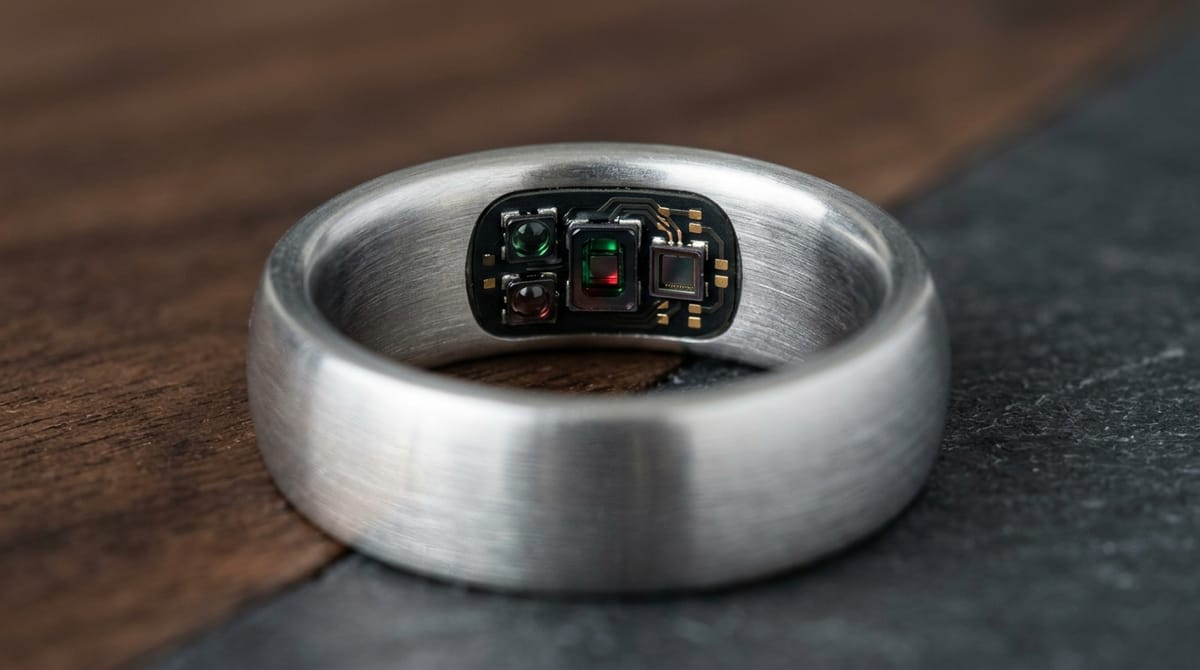
The gold standard for HRV is a single-lead ECG (chest strap or medical Holter monitor) which detects each R-wave directly. Consumer smart rings use photoplethysmography (PPG) - green and red LEDs that measure blood-volume changes through the skin - and infer heartbeats from the PPG waveform. That inference adds noise: the PPG waveform's peak doesn't correspond exactly to the ECG R-wave, motion artifacts during sleep cause beat-detection errors, and the sampling rate (typically 25-100 Hz) is lower than ECG.
The practical effect: ring-measured RMSSD usually correlates with chest-strap RMSSD in the 0.7-0.9 range for a single night, but with absolute-value errors of 5-20 ms. For trend-tracking across weeks, that error averages out and the ring is genuinely useful. For single-night recovery calls ("my HRV is 35 today, do I train?"), the noise floor is meaningful - your real HRV might be anywhere from 25-45 given the measurement error.
How the leading rings actually compare on HRV
The most rigorous public-domain HRV-validation source for smart rings is Quantified Scientist's direct comparisons against a Polar H10 chest strap across multi-night testing. His published results show genuine differences between the leading rings - though all four major players land within usable range for trend-tracking purposes.
| Oura Ring 4 | Ultrahuman Ring Air | Samsung Galaxy Ring | RingConn Gen 2 | |
|---|---|---|---|---|
| HRV agreement vs chest strap | Highest published correlation (~0.85-0.90 night-by-night) | ~0.80-0.85 correlation; close behind Oura | ~0.75-0.80 correlation; broader variance per night | ~0.70-0.78 correlation; least tight of the four |
| Subscription required | £5.99/mo for full HRV data | No - included with hardware | No (Samsung Health Premium optional) | No |
| Sampling | High-frequency PPG (claimed industry-leading) | Comparable PPG to Oura, fewer published validation studies | Standard PPG; less validation data published | Lower-power PPG (longer battery, less HRV resolution) |
| Best for | HRV-led training decisions where accuracy matters most | Best HRV value if you can't justify Oura subscription | Samsung-ecosystem users; weakest HRV pick of the four | Budget HRV tracking, trend-only - not single-night decisions |
When to use ring HRV - and when not to
Trend-tracking across weeks/months. Use ring HRV to spot patterns - your HRV trending down across a week is a real signal of accumulated stress, sleep debt, or illness building up. The measurement noise averages out over 7+ nights.
Spotting acute illness early. A sharp HRV drop (15-25%+ below your personal 30-day average) often precedes subjective illness symptoms by 24-48 hours. Useful early-warning signal even at consumer-grade accuracy.
Calibrating recovery vs training. For amateur endurance athletes, a multi-day HRV trend is a usable input to whether today is a hard-session day or a recovery day. The single-day reading is noisy; the 3-7 day trend isn't.
Confirming the cost of bad habits. Three drinks the night before reliably crashes ring HRV by 20-40%. Late-night caffeine, poor sleep timing, and stress all show up. Useful behavioural-feedback loop.
Don't use ring HRV for clinical decisions. The accuracy isn't there for cardiovascular-risk assessment, arrhythmia detection, or any medical purpose. If you're using HRV as a health indicator, layer it on top of GP-level cardiovascular screening - not as a substitute.
Don't compare absolute HRV across people. 60 ms RMSSD is not 'better' than 30 ms RMSSD - HRV varies dramatically by age, sex, fitness, body type, and individual biology. Your own trend is the only HRV number worth obsessing over.
Don't trust single-night readings. Per-night measurement noise means a single 'low HRV today' reading might just be measurement variance. Look for 3+ consecutive nights of low values before reading it as signal.
Should you upgrade from a current ring for HRV specifically?
If you have Oura Ring 3 → don't upgrade for HRV alone
The Oura Ring 3 to Ring 4 HRV-accuracy improvement is real but modest (~5-10% tighter night-by-night correlation in published comparisons). The full Ring 4 case is build quality + battery + Reach algorithms, not HRV specifically.
If you have Ultrahuman Ring Air and want better HRV → consider Oura Ring 4
The Oura HRV-accuracy advantage over Ring Air is the most defensible reason to add Oura's £5.99/mo subscription on top of the £349 hardware. For pure trend-tracking, Ring Air is fine; for tighter night-by-night calibration, Oura wins.
If you have RingConn Gen 2 → upgrade is justified only at the trend-tracking level
The RingConn HRV is usable for trends but noisier for single-night calls. If you're making training-or-recovery decisions on the daily HRV reading, Oura or Ultrahuman are real upgrades. If you're only watching weekly trends, RingConn is fine.
If you don't have a smart ring yet → pick by use case, not just HRV
HRV is one of many ring metrics. See our overall 2026 rankings for the broader picture - sleep tracking, battery life, subscription, etc. HRV-led picks tend to be Oura or Ultrahuman regardless of other factors.
Frequently asked questions
Which smart ring has the most accurate HRV?
How accurate is smart-ring HRV compared to a chest strap?
Why is my smart-ring HRV different to my Apple Watch HRV?
What's a 'good' HRV number?
Can I use smart-ring HRV to manage training load?
Oura Ring 4 Review
Ultrahuman Ring Air Review
Best Smart Ring for Sleep Tracking 2026