Smart Ring for Travel & Jet Lag (UK 2026)
Smart rings for travel + jet lag - circadian shift tracking, HRV recovery, sleep recovery patterns. Oura, RingConn, Ultrahuman for UK long-haul travellers.
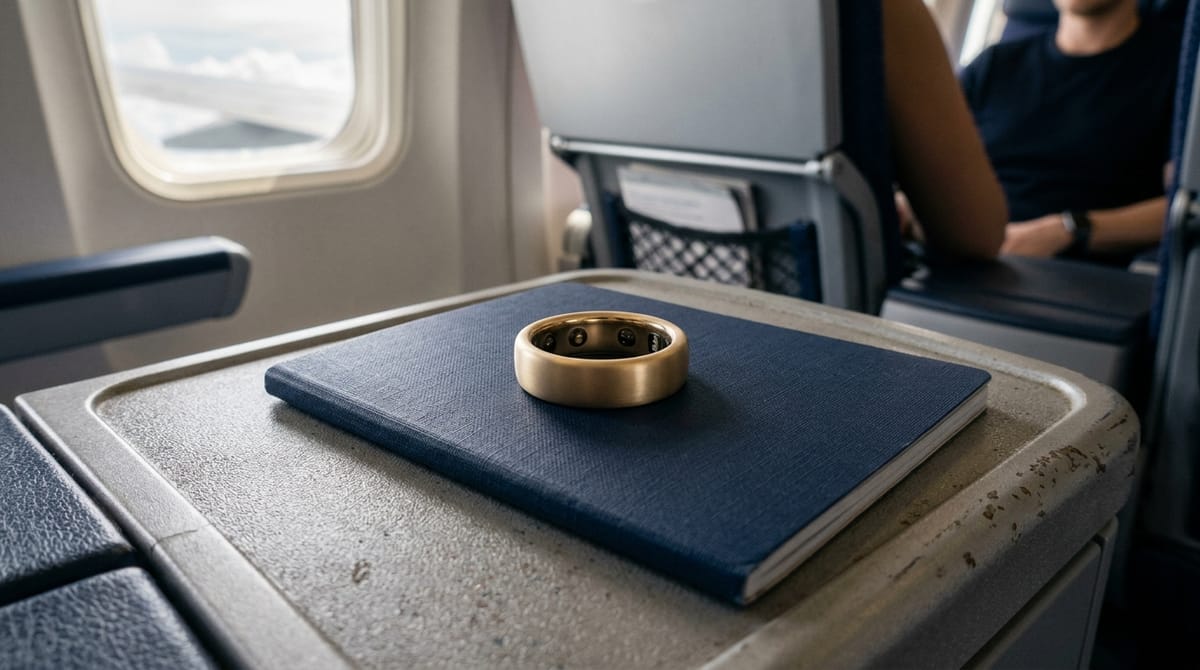
Long-haul travel disrupts the circadian rhythm in measurable ways - sleep timing, HRV, body temperature, and recovery metrics all shift. Smart rings catch this in 24/7 data that simpler tracking apps don't capture. For UK travellers regularly crossing 5+ time zones (the UK long-haul cohort includes Asia-Pacific business travellers, US East Coast crossings, and Middle East routes), the ring data gives an objective view of how long jet lag actually takes to clear - typically longer than people assume. This guide covers what 2026 smart rings actually measure during travel and how to use the data for faster recovery.
What does the ring actually show during jet lag?
Three measurable signals during the first week at a new time zone:
HRV suppression and recovery curve. HRV typically drops 25-50% in the first 48 hours after arrival, then gradually recovers over 5-7 days. The recovery curve is steeper for younger travellers and shallower for travellers over 50 or those with existing low baseline HRV. The ring's daily HRV trend shows this clearly - the recovery is the meaningful signal, not the initial drop.
Sleep stage disruption. The first 2-3 nights at a new time zone typically show: total sleep duration unchanged or slightly increased, but with substantially reduced REM sleep (the circadian-controlled REM windows are misaligned) and increased deep sleep concentrated in the first half of the night. As circadian rhythm shifts, REM and deep sleep gradually redistribute to their normal proportions across the night.
Skin temperature phase shift. Core body temperature has a 24-hour circadian rhythm with a low point around 4-5am local time pre-travel. After a time zone shift, this temperature low point continues happening at the pre-travel time, which is a different local time - causing the 'wide awake at 3am' or 'crashing at 8pm' experience. The smart ring's skin temperature tracking shows when the phase shift completes - typically 3-7 days post-arrival.
Which smart ring is best for travel use?
Oura Ring 4 (£399 + £5.99/month). Oura's jet lag recovery view is the most polished in 2026. The Recovery Timeline visualisation shows HRV recovery curve, sleep stage normalisation, and temperature phase shift overlaid on a single 7-day chart. The app provides specific guidance ('your circadian rhythm is 2 days behind local time - consider morning light exposure'). For frequent long-haul travellers the feature-set premium is justified.
RingConn Gen 3 (£349, no subscription). No travel-specific feature but the underlying data is all there. Skin temperature tracking + HRV trend + sleep stage data give the full picture. Best for travellers comfortable interpreting raw data and prioritising no-subscription ownership.
Ultrahuman Ring Pro (£449, no subscription). The Recovery PowerPlug specifically surfaces jet lag context. Combined with the Ultrahuman M1 CGM (if used together), the metabolic dimension is also visible - long-haul travel disrupts insulin sensitivity for 3-5 days post-arrival.
Samsung Galaxy Ring (£399). Strong data but Samsung Health's travel-specific framing is less developed than Oura's. Best for Samsung-ecosystem users who'd value the SmartThings integration.
How do you use the ring data to recover faster?
Practical use of the data during travel:
- Use the ring's local-time auto-adjustment. All 2026 major-brand rings detect time zone changes via the phone's GPS and adjust sleep tracking automatically. Don't manually override - the auto-detection works.
- Track HRV trajectory, not absolute number. HRV will drop after long-haul - that's expected. What matters is the recovery curve. Day 5 HRV approaching pre-travel baseline = recovery on track. Day 5 still at 50% baseline = recovery delayed, consider additional rest.
- Use sleep stage data to time light exposure. If deep sleep is concentrated unusually early in the night (e.g. midnight to 2am rather than the usual 1am-4am), the circadian rhythm hasn't shifted yet. Morning light exposure (within 30 min of waking) accelerates the shift.
- Skip the early-morning HIIT. The ring's Readiness score (Oura) or recovery indicator (Ultrahuman) typically reads 'amber' or 'red' for the first 3-4 days of a major time zone shift. Following the guidance and skipping high-intensity training for those days isn't laziness - it's appropriate use of the data.
- For business travellers: time meetings to circadian peak. The ring's resting heart rate trend through the day shows when the body is in peak alert state. Schedule the most important meetings for the body's peak window rather than the local-time convenience window for the first 3-4 days.
Frequently asked questions
How long does jet lag actually last according to smart ring data?
Is the Oura jet lag feature worth the subscription?
Does the ring detect time zone changes automatically?
Can I use smart ring data to optimise my flight schedule?
What's the practical use of skin temperature tracking for travel?
HRV Explained for Smart Ring Users
Best Smart Ring for Sleep Tracking
Best Smart Rings 2026