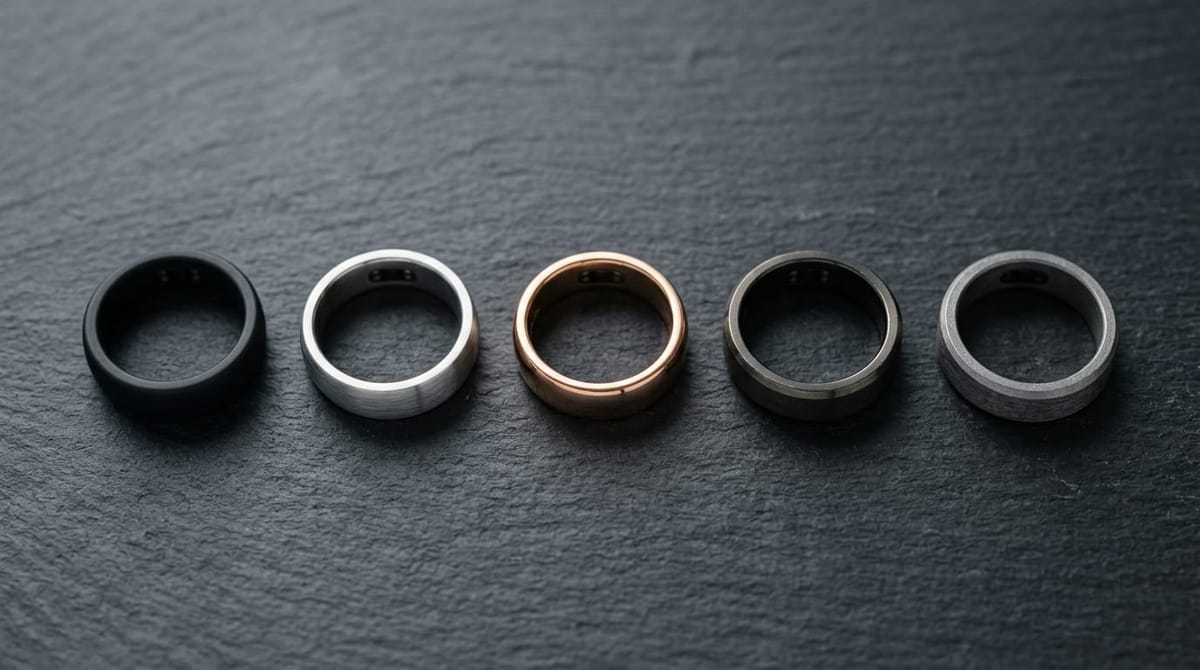
Can a Smart Ring Help Track Migraines? Honest Look
Can a smart ring help track migraines? What HRV, sleep and temperature data reveal about your triggers - and the honest limits of wearable data.

Smart ring migraine tracking is one of the more hopeful ideas in wearable health: the notion that a ring on your finger could warn you an attack is coming before the pain arrives. The reality is more measured. A ring records your body's signals, not your brain's activity, and migraine is fundamentally a neurological condition.
That does not make the data useless. There is genuine research linking the autonomic nervous system - the part that controls heart rate, sleep and temperature regulation - to migraine. A ring sits close to that signal. The question is whether passive tracking turns into something you can actually act on, and the honest answer depends a lot on the person.
Can a smart ring detect or predict a migraine?
No consumer smart ring can detect or predict a migraine in the clinical sense. There is no sensor for head pain, aura, or the brain changes that drive an attack. What a ring offers is indirect: it tracks physiological markers that research has associated with migraine, and leaves you to join the dots.
The most promising of these markers is autonomic balance. Studies of people with episodic migraine consistently find altered heart rate variability (HRV - the small beat-to-beat timing changes in your pulse), especially during the period around an attack. In principle, a sustained dip in HRV or a poor night's sleep could flag a higher-risk day. In practice, those same signals shift for dozens of unrelated reasons - a late meal, a hard workout, a glass of wine, a stressful email - so a single number rarely means "migraine incoming".
What does a smart ring actually measure?
Understanding the limits starts with knowing what is genuinely being recorded. A modern smart ring tracks a handful of metrics relevant to migraine sufferers:
Heart rate variability (HRV). The headline metric. Lower HRV broadly reflects more physiological stress and less recovery capacity. Because migraine is tied to autonomic function, HRV is the signal most often discussed in a migraine context.
Resting heart rate. A rising overnight resting heart rate is an early sign your body is under load - from illness, poor sleep, or stress - all of which are common migraine triggers.
Sleep. Rings estimate sleep duration and stages reasonably well at the trend level. Since both too little and disrupted sleep are among the best-established migraine triggers, this is arguably the most actionable data a ring provides.
Skin temperature. Rings log nightly temperature deviation from your personal baseline. The migraine evidence here is thin, so treat any temperature pattern as a curiosity rather than a warning sign.
How can HRV and sleep data help with migraine?
The realistic benefit is pattern-spotting over weeks, not real-time prediction. A ring builds a continuous record of your sleep and recovery, and that record is far more reliable than memory when you sit down to work out what preceded an attack.
The autonomic link is real. A cross-sectional study of episodic migraine published in the US National Library of Medicine found measurably reduced HRV in migraine patients compared with controls, supporting the long-held view that autonomic dysfunction plays a role in the condition (NCBI, Heart Rate Variability Analysis in Episodic Migraine). The practical catch is that this research uses controlled measurement, not a ring worn during everyday life.
Where a ring earns its place is as a structured trigger diary. If you log attacks against your ring's sleep and HRV history, patterns can surface - a run of short nights before a cluster of headaches, or a sharp recovery dip the day before. That is a conversation worth having with your GP, and it is far more useful than the ring's own "readiness" score.
Where smart rings fall short for migraine
The gap between a wellness signal and a clinical one is wide, and migraine sits squarely in it. Three limits matter most.
First, correlation is not prediction. Low HRV is associated with migraine at a population level, but your low-HRV morning is far more likely to end without a headache than with one. Acting on every dip would mean cancelling plans constantly.
Second, the data can feed anxiety. For some people, watching recovery scores fluctuate becomes its own stressor - and stress is itself a migraine trigger. That feedback loop is real and worth guarding against.
Third, a ring measures one wrist's worth of physiology. It knows nothing about the dietary, hormonal, visual, and environmental triggers that drive a large share of migraines. Relying on it as your main early-warning system means ignoring the factors that often matter more.
Should you use a smart ring if you get migraines?
For many people, yes - with the right expectations. If you already want better sleep insight and a low-effort record of your recovery trends, a ring is a comfortable, unobtrusive way to gather it, and that record can genuinely sharpen a trigger-tracking effort.
It is the wrong purchase if you are buying it specifically to predict attacks, or if you are prone to health anxiety that data tends to amplify. No ring on the market in 2026 delivers reliable migraine forecasting, and any marketing that implies otherwise is overselling. If you want a starting point on the hardware itself, our guide to the best smart rings covers which models track HRV and sleep most credibly. For the broader stress picture, our look at stress and anxiety tracking applies the same honest lens.
What actually helps with migraine?
A ring is, at best, a supporting tool. The interventions with real evidence behind them sit outside the wearable entirely: identifying and managing personal triggers, keeping consistent sleep and meal timing, staying hydrated, and working with a GP on acute and preventive treatment where attacks are frequent.
A simple paper or app-based migraine diary - recording each attack, its severity, and the day's food, sleep, stress and hormonal context - remains the single most useful self-tracking habit, and it is what most headache specialists ask for. A smart ring can feed objective sleep and recovery numbers into that diary, but the diary, and the clinical care around it, does the heavy lifting.
Frequently asked questions
Can a smart ring predict a migraine before it starts?
Which smart ring metric is most useful for migraine sufferers?
Is HRV from a smart ring accurate enough to track migraine triggers?
Should I see a doctor instead of relying on a smart ring?
HRV Explained: What Smart Rings Actually Measure
Smart Ring Temperature Tracking Accuracy
Best Smart Ring for Sleep Tracking