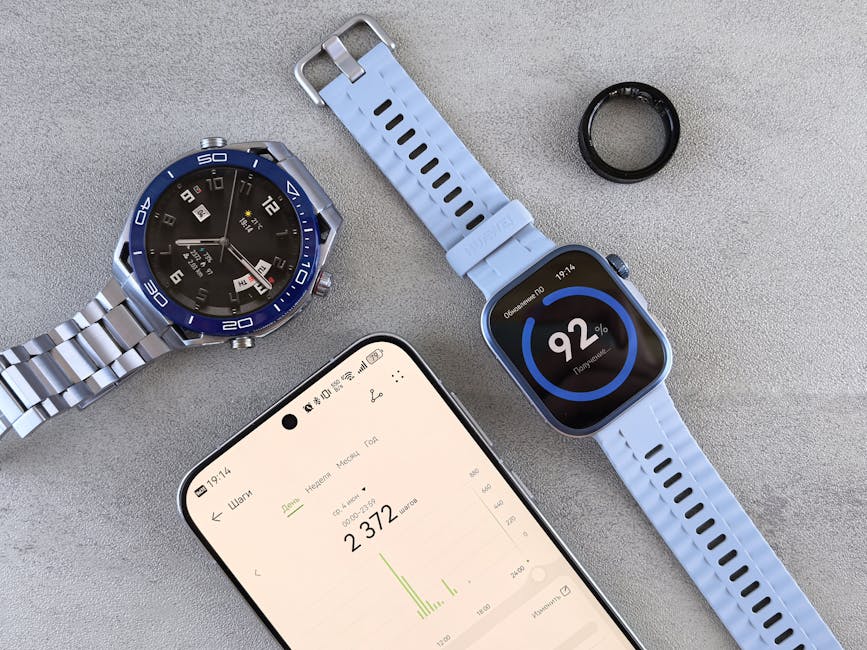
Smart Ring vs Smartwatch: The Honest 2026 Comparison
Rings win on sleep, HRV and battery; watches win on workouts, ECG and notifications. The evidence-based 2026 guide to picking the right one.
Whether to buy a smart ring or a smartwatch is the most common question new wearable shoppers ask, and the marketing on either side is unhelpfully one-sided. The honest answer is that the two devices are good at different things, the evidence on which one wins is unambiguous in some categories and surprisingly close in others, and a meaningful number of buyers end up with both. This 2026 guide walks through the comparison metric by metric, cites the peer-reviewed studies where they exist, and gives three direct recommendations at the end based on what you actually want the device for.
The companion piece to this comparison is our smart ring buying guide, which covers what to look for within the ring category once you have decided that direction. Read this comparison first if you are still choosing between form factors.
1. The form-factor split — what each device actually measures well
Both smart rings and smartwatches use the same underlying optical technology — photoplethysmography, or PPG — to detect blood-volume changes through the skin via green and red LEDs and a photodiode. The difference between the two form factors is almost entirely about where the sensor sits and how often that location is stable.
A ring sits in firm circumferential contact with a single finger. The finger has thinner soft tissue, denser capillaries near the surface, and far less motion than the back of the wrist. A 2023 review of PPG sensor design published in Measurement identifies motion artifacts as the primary published weakness of PPG sensors, which is exactly the failure mode the wrist experiences most. The same review notes that PPG accuracy is approximately 15% worse on darker skin than lighter skin because melanin absorbs the green wavelengths the sensor depends on — a limitation that applies to both rings and watches but is mitigated on rings by their better contact and reduced motion.
The practical translation is that rings produce better signal at rest (sitting at a desk, on the sofa, in bed) and watches produce better signal during active wear (walking, running, cycling, talking with hands). Both produce excellent signal when the wearer is asleep, but only one of them is comfortable to sleep in.
2. Sleep tracking — where the smart ring wins decisively
Sleep is the category where the published evidence is least ambiguous. A 2024 head-to-head study published in PubMed Central compared the Oura Ring, Apple Watch and Fitbit against polysomnography — the EEG-and-electrode clinical gold standard — across multiple nightly sleep measures. The findings are stark enough to summarise without hedging:
- The Oura Ring showed substantial agreement with polysomnography on sleep-stage determination (Cohen's Kappa > 0.61) — better than either wrist-worn device.
- The Oura Ring's nightly summary statistics were not significantly different from polysomnography on seven of eight measures (sleep onset, total sleep, wake after sleep onset, light/deep/REM minutes, sleep efficiency).
- The Apple Watch underestimated deep sleep by 43 minutes and overestimated light sleep by 45 minutes per night, on average, versus the same lab reference.
- The Fitbit and Apple Watch both had data-collection failures during the study — some participants' devices simply did not log a usable night. The Oura Ring did not have this problem.
- All three devices, including the watches, were > 95% sensitive at the simpler question of "is this person asleep right now" — the gap opens up specifically on staging, not on basic sleep detection.
Two practical reasons drive the gap. First, sleep tracking depends on continuous, motion-free sensor contact for several hours, which a ring delivers and a watch struggles with — especially for people who sleep on their side. Second, compliance is meaningfully higher with rings; people who buy them tend to wear them at night, while a significant share of smartwatch owners take them off before bed because the band is uncomfortable to sleep in. The most accurate device in your drawer is worth zero.
If sleep, recovery and HRV trending are your strongest motivations for buying a wearable at all, the smart ring is the categorical right answer. The companion buying-guide pillar covers how to pick between the rings themselves.
3. Workouts and active exercise — where the smartwatch wins decisively
Active exercise is the mirror image. A 2023 validation study published in PubMed Central tested four wrist-worn devices against chest-strap ECG across a range of exercise intensities and reported two findings that apply to the ring-vs-watch comparison as well:
- Wrist-worn PPG accuracy degrades sharply above 150 bpm because hand and arm motion contaminates the optical signal. Some devices in the study underestimated heart rate substantially during intense effort.
- Devices were more accurate during steady-state cycling than treadmill running — published evidence behind the folk observation that wrist-based heart rate "works better on the bike than the road."
- The study notes that only an estimated 5% of wearable heart-rate technologies have been formally validated, so what is published applies primarily to the major-brand devices that have been peer-reviewed.
The same physical limit applies to smart rings — they are PPG devices too — but rings have an additional disadvantage that watches do not: they are even more vulnerable to motion artifacts because the hand moves more independently than the wrist during workouts. Manufacturer documentation across the major ring brands explicitly recommends pairing the ring with a chest strap or smartwatch for accurate workout heart rate; the ring's own active-exercise data is best treated as approximate.
The other place the watch wins on workouts is GPS. Smart rings do not have GPS and rely on phone-based position. A watch that contains its own GNSS chip can record a workout without a phone, which matters for runners, cyclists, swimmers, and anyone who does not want to carry a 200-gram piece of glass on every training session. Apple Watch Ultra and the higher-tier Garmin / COROS devices also include dual-frequency GPS, which is meaningfully more accurate in tree cover and urban canyons than a phone's single-frequency receiver.
If your primary use case is structured exercise — pace, splits, intervals, heart-rate zones, workout-specific metrics — the smartwatch is the categorical right answer, with a chest strap on top if you take training seriously.
4. ECG, AFib screening and clinical-grade features — watch-only territory
Smart rings do not, as of mid-2026, have FDA or MHRA clearance for any ECG-class feature. Smartwatches do, and this is the single category where the watch is not merely better but uniquely capable.
The American College of Cardiology's 2024 review of smartwatch atrial-fibrillation detection summarises the headline clinical performance:
- The Apple Heart Study reported that the Apple Watch's irregular-pulse notification had an 84% positive predictive value for atrial fibrillation across 2,064 patients who received the alert.
- The Fitbit Heart Study reported a 98.2% PPV for AFib when consumer-grade irregular-rhythm screening was paired with medical-grade ECG confirmation.
- Pooled meta-analyses report smartwatch AFib detection sensitivity around 96% and specificity around 94% — strong for a wrist-worn screening device.
Harvard Health's 2023 overview identifies five smartwatch families with formal ECG clearance: the Apple Watch, Samsung Galaxy Watch, Withings ScanWatch, Fitbit Sense and the AliveCor KardiaMobile (the last being a separate finger-pad device rather than a watch, but commonly grouped with the category). The same review notes two important caveats that the marketing tends to omit:
- About 25% of ECG readings from a head-to-head validation of those five devices were deemed "inconclusive" — even on cleared hardware, a meaningful share of single-lead readings cannot be classified.
- There are no randomised trials demonstrating that smartwatch AFib screening improves hard clinical outcomes (stroke, mortality). The Cleveland Clinic Journal of Medicine's 2024 review states this directly, and also notes that positive predictive value drops to 19.3–37.5% in asymptomatic adults age 65 and older — exactly the group most likely to be told to screen.
The Cleveland Clinic review adds one more point that matters: there is a large gap between consumer-grade and medical-grade devices for detecting arrhythmias more complex than AFib — atrial flutter, premature ventricular contractions, supraventricular tachycardias and so on. A single-lead consumer ECG is a screening tool for one specific rhythm, not a substitute for a 12-lead diagnostic.
The honest read: if you have a family history of AFib, palpitations of unknown cause, or are over 65, the ECG feature on a smartwatch is a real clinical value-add. If you do not, it is a feature you will use once on the day of unboxing and rarely thereafter — and it is not a reason to pick a watch over a ring on its own.
5. Battery life and charging cadence
Battery life is the single most lopsided category, and it shapes daily-use habit more than any feature comparison.
- The Oura Ring 4 claims about 7–8 days on a charge in normal use, per Tom's Guide's coverage.
- The Samsung Galaxy Ring claims about 6–7 days, varying by ring size (the larger sizes have more battery).
- The Apple Watch Series 10 lasts approximately 18 hours on a normal charge and around 36 hours in Low Power Mode, per TechRadar.
- The Google Pixel Watch 3 claims approximately 24 hours.
- Garmin and Apple Watch Ultra-tier devices stretch this to several days at the cost of significant size and weight.
The practical translation is that a ring fits into the natural shower-and-shave window — you take it off, drop it on a 20–90-minute charging puck while you get ready, and put it back on. A standard smartwatch needs a nightly cadence and is therefore the device most likely to be off your wrist during the hours sleep tracking matters most. The watch-side mitigation is to charge in the morning rather than overnight; this works but takes some discipline.
Battery is also the single biggest determinant of whether you actually wear the device. A wearable on a charger generates zero data. Rings have a meaningful structural advantage here.
6. Notifications, apps and daily-life UX
This is the category the comparison almost always under-weights — and it is the category that tips the most casual buyers toward a watch.
A smartwatch is, fundamentally, a small screen on your wrist. It shows the time, surfaces notifications, runs a fast-growing catalogue of apps (Spotify, Strava, Uber, boarding passes, voice assistants), and offers tap-to-pay through Apple Pay or Google Wallet. The Apple Watch and Galaxy Watch can take cellular calls without a phone. None of this is possible on a smart ring — rings have no screen, no speaker, and no microphone (with one or two early exceptions). A ring is a sensor, not an interface.
Whether the smartwatch's UX surface is an advantage or a tax depends on what you want from the device. Buyers who already feel over-notified can prefer rings precisely because they remove the wrist-buzz pressure. Buyers who like glanceable information — meeting reminders, message previews, paying for a coffee without unlocking the phone — will find a ring underwhelming after a week.
The app ecosystems also differ in maturity. The Apple Watch and Galaxy Watch run on platforms with several thousand third-party apps each and a decade of developer investment. The major ring apps (Oura, Ultrahuman, RingConn, Samsung) are good at their core job — health and sleep summaries — but their feature surface is narrower and changes more often. If you want to track a specific workout type or integrate with a specific health platform, check whether the ring app supports it before buying. Almost every premium ring writes back to Apple Health and Google Health Connect, but feature parity inside the proprietary platforms (Samsung Health on Samsung phones especially) is uneven.
7. Price, subscription and three-year total cost
The most-asked question about price is whether the smart ring is cheaper. The honest answer is "it depends on the subscription model."
Smart-ring hardware in 2026 ranges roughly:
- Entry-level (Amazfit Helio, RingConn Gen 2): £99–£299
- Premium (Oura Ring 4, Ultrahuman Ring Air, Samsung Galaxy Ring): £349–£499
- Flagship finishes (gold, brushed titanium): £449–£549
Smartwatch hardware ranges roughly:
- Entry-level (Apple Watch SE, Pixel Watch base): £249–£329
- Mid-tier (Apple Watch Series 10, Galaxy Watch 7): £399–£499
- Flagship (Apple Watch Ultra 2, Garmin Fenix 8, Galaxy Watch Ultra): £649–£900+
Hardware-only, the ring is in the same band as a mid-tier smartwatch. The complication is recurring cost. Oura locks the bulk of its features behind Oura Membership, currently £4.99/month in the UK or $5.99/month in the US ($69.99 annually) — a fact we cover in detail in the buying guide. Over three years of ownership, that is an extra £180 / $215 on top of the hardware. The competing premium rings (Ultrahuman, RingConn, Samsung) are subscription-free.
Smartwatches do not generally charge a recurring fee for core fitness features, though some third-party platforms (Strava Premium, Garmin Coach, AllTrails+) layer optional subscriptions on top. Cellular models add a monthly carrier fee.
A reasonable three-year total-cost comparison for a typical buyer looks like:
- Oura Ring 4 + Membership: ~£349 hardware + ~£180 subscription = ~£529
- Ultrahuman Ring Air (subscription-free): ~£349 hardware = ~£349
- Apple Watch Series 10 (GPS): ~£399 hardware = ~£399
- Samsung Galaxy Ring (subscription-free): ~£399 hardware = ~£399
The flagship Apple Watch Ultra and Garmin Fenix tier sit considerably higher; the entry-level Amazfit Helio Ring sits considerably lower. Pricing changes regularly — check the brand storefront for current pricing before you commit.
Who should buy which — three honest recommendations
After working through the metric-by-metric comparison, three buyer profiles fall out clearly.
Buy a smart ring if:
- Your strongest motivation is sleep, recovery, HRV trending, or resting-heart-rate accuracy.
- You already own a phone that does notifications well and do not want a second notification surface on your wrist.
- You find wristbands uncomfortable to wear continuously, or you wear a mechanical watch you do not want to displace.
- You value 7-day battery life over daily charging.
- You are comfortable using your phone as the workout-tracking device when you train.
Buy a smartwatch if:
- Your primary use case is structured training — pace, intervals, heart-rate zones, GPS routes, workout-specific metrics.
- ECG-class features matter to you because of personal or family cardiac history.
- You actively want glanceable information on your wrist: messages, calls, calendar, contactless payment, music control.
- You are happy with a nightly or morning charging routine.
- You do not particularly care about sleep tracking, or you would not wear the device to sleep regardless of form factor.
Buy both if:
- Sleep tracking and structured training both matter, and you have the budget to split the use cases.
- You want the most accurate health data the consumer market offers without compromising on workout precision — the ring handles overnight and recovery, the watch handles training, and the apps merge the data via Apple Health or Health Connect.
- Buying both is a meaningful share of the smart-ring market — manufacturer marketing tends to position rings and watches as substitutes, but in practice the metrics they measure best barely overlap, and the two devices stack better than they overlap.
The shortcut, if you do not want to read further, is to identify your single strongest motivation. If it is sleep or recovery, a ring is almost certainly the right answer. If it is training or ECG, a watch almost certainly is. Everything else is a tiebreaker.
Frequently asked questions
Is a smart ring or smartwatch more accurate for heart rate?
Can a smart ring replace a smartwatch entirely?
Which has better battery life — smart ring or smartwatch?
Do smart rings have ECG like the Apple Watch?
Do I need a subscription with a smart ring?
Will wearing a smart ring and smartwatch at the same time cause problems?
Are smart rings or smartwatches better for women's health tracking?
Decided on a ring? Pick the right one next
Our buying guide walks through subscription, sizing, sensor accuracy, app ecosystem, durability and current patent status — the seven factors that decide whether a £349 ring earns its place on your hand.