Can You Wear a Smart Ring in an MRI? (Safety Answer)
No - remove your smart ring before an MRI. Why the scanner damages ring electronics, what X-rays and airports do differently, and scan-day tips.
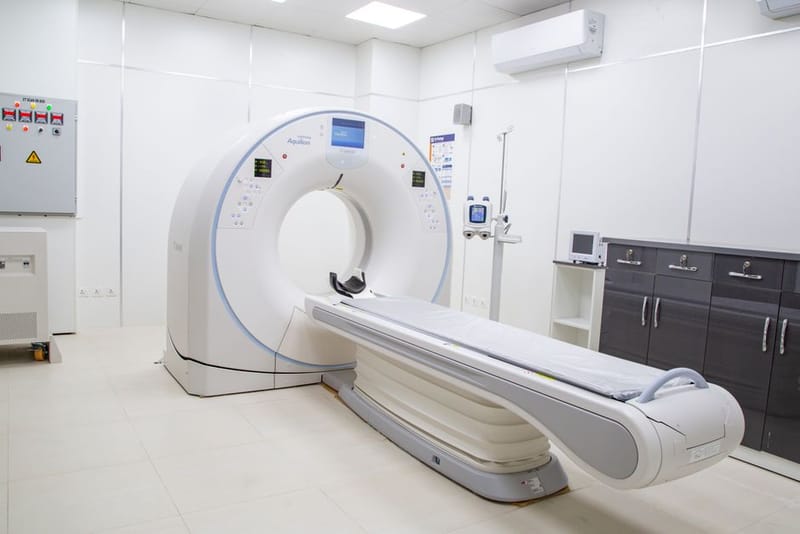
This question matters because smart rings are designed never to come off - people shower, swim and sleep in them, so an MRI appointment is one of the few genuine removal moments. The answer is an unambiguous no, but the reasons are worth two minutes, because they also explain what the scan would otherwise do to your £300 ring.
Why can't a smart ring go in an MRI?
Three separate problems
1. The scanner versus the ring. An MRI's magnetic field is measured in teslas - tens of thousands of times Earth's field - and it flips rapidly during imaging. Those changing fields induce currents in any conductive loop, and a metal ring wrapped in coils, a battery and a circuit board is exactly that. The result can be a corrupted sensor, a damaged battery or a dead ring. Most manufacturers' warranties will not look kindly on scanner damage, and Oura explicitly instructs removal for MRI, X-ray and CT.
2. The ring versus your scan. Metal near the imaging area creates artefacts - distorted, signal-voided patches that can make images unreadable. Even for a head scan, radiographers remove hand jewellery as routine because artefact behaviour is not worth gambling a rescan on.
3. The ring versus your finger. Induced currents heat metal. A solid band that cannot be quickly slipped off a swelling finger is precisely what MRI safety screening exists to catch. Titanium being only weakly magnetic does not exempt it - heating and induction affect conductive metals regardless of whether they are ferromagnetic.
What about X-rays, CT scans and airport security?
Graduated answers
X-ray and CT: no magnetic risk to you, but manufacturers still advise removal - ionising radiation at diagnostic doses is unlikely to harm the electronics, and the real reason is imaging artefacts: the ring is radio-opaque and will shadow whatever is behind it. Removal takes two seconds; do it.
Airport security: completely fine. Metal detectors and body scanners use fields and millimetre waves that are orders of magnitude gentler than an MRI. Most wearers walk through without triggering anything; at worst you get a manual check. No manufacturer advises removing a ring to fly.
Everyday magnets (induction hobs, magnetic phone mounts, speaker magnets) are harmless to a smart ring at normal distances.
Practical tips for scan day
Protect the data streak too
Take the ring off at home and leave it on its charger - an MRI appointment is a convenient top-up window, and a charging ring is a ring you cannot forget in a hospital locker tray. If you track sleep streaks or recovery scores, a few hours' gap in daytime data barely registers in any ring's scoring model. And mention every implant or wearable at the safety screening anyway - that conversation is the system working, not an inconvenience.